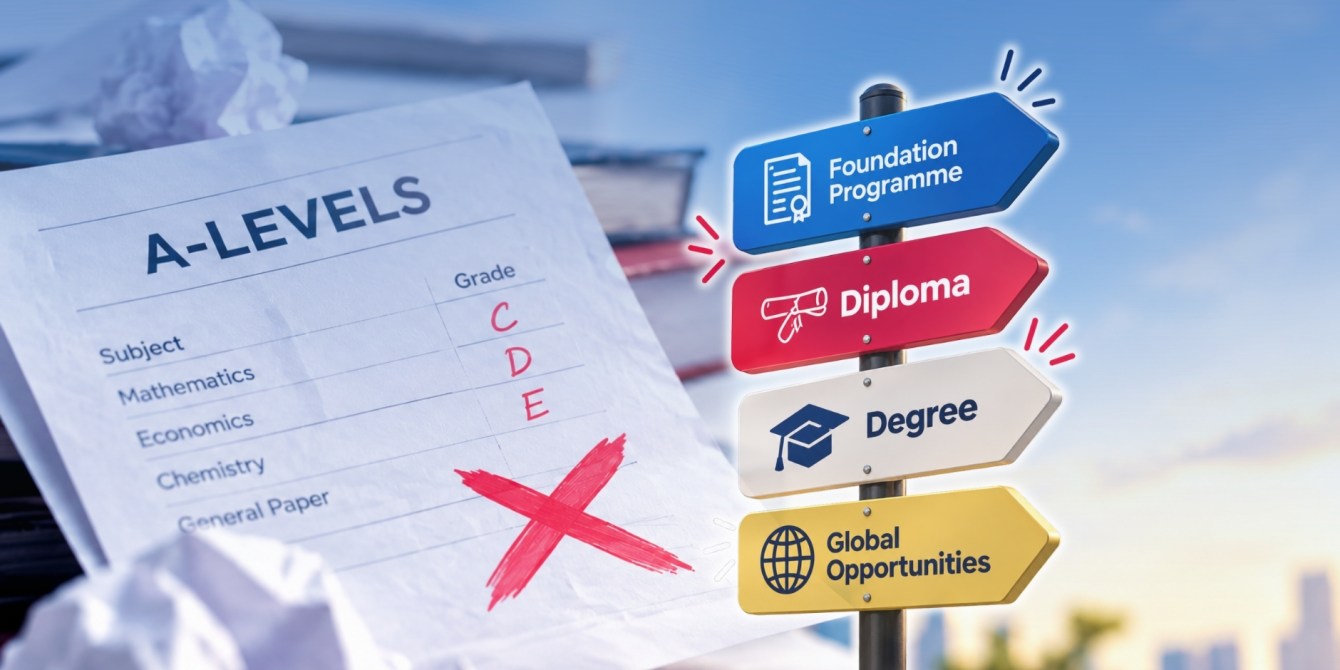
Not every student follows the traditional university pathways:
O Levels → A Levels → University Route.
Completing A-Levels are one route into higher education in Singapore, but not the only option.
Students with GCE O-Levels, IGCSEs or equivalent international qualifications can explore pathways beyond O Levels through Singapore Private Education Institutions (PEIs) such as LSBF Singapore Campus.
So, if you want to study in Singapore without A-Levels, the first step is to check which higher education pathways are open to you with your current qualification.
Explore Your Higher Education Pathways in Singapore
Singapore PEIs offer alternative pathways to higher education, including foundation-to-degree or diploma-to-degree routes.
These PEIs partner with universities abroad to offer industry-relevant, recognised bachelor’s degrees that students can pursue in Singapore.
LSBF Singapore Campus programmes, a recognised Singapore PEI, offer these pathways to degrees awarded by UK University Partners such as the University of East London, the University of Greenwich, the University of Chichester, and the University of Roehampton.
Here are some education pathways you can explore in Singapore:
| Your Current Qualification | Pathway You Can Explore | What It Involves | Potential Outcome |
| Qualification that meets the degree entry requirements | Direct Entry → bachelor’s degree | You apply directly to a bachelor’s degree if you meet the required academic, subject and English-language requirements. | Start a bachelor’s degree without first completing a foundation or diploma. |
| Qualification that does not meet the direct degree requirements but meets diploma requirements | Diploma → bachelor’s degree | Build subject knowledge and practical skills through a diploma before progressing to a related degree. | Progress to a bachelor’s degree, subject to the programme entry requirements. |
| Qualification that requires additional academic preparation | Foundation Programme → Diploma → Degree | Build basic academic, subject and study skills before moving to higher-level study. | Progress to a diploma and then to degree, depending on the programme’s progression requirements. |
| Diploma or equivalent qualification | Diploma → Higher/Advanced Diploma (where required) → bachelor’s degree | Continue to a higher-level diploma before progressing to a related bachelor’s degree, where available. | Enter a bachelor’s degree with advanced standing or through a top-up route, subject to the university’s requirements. |
Important: These are examples of possible routes, not a fixed sequence that every student must follow. Each institution and programme has its own entry and progression requirements.
A real-life example of pursuing an alternative higher education pathway in LSBF Singapore Campus
LSBF Singapore Campus student Bryan Mak’s journey shows that the traditional A-Level route is not the only way to progress towards higher education in Singapore.
After leaving school in Secondary 3, he later completed his N Levels before taking a Foundation Programme. He is now pursuing a Higher Diploma in Computer Science at LSBF Singapore Campus .
Bryan is now one step closer to his goal of building a career in cybersecurity in Singapore.
His journey shows how one qualification can become a stepping stone to the next, depending on your academic background and the progression options available.
What Can You Study Through These Pathways?
Options can include:
LSBF Singapore Campus programmes cover several of these subject areas, with diploma and higher diploma pathways that can lead to bachelor’s degrees. Many of these subject areas connect to sectors in Singapore that need skilled professionals.
The curricula also combine theoretical knowledge with practical learning, helping you build both the subject knowledge and practical skills needed for further study and the workplace.
These programmes also offer a fast-track route to pursuing a bachelor’s degree in Singapore without following the traditional A-Level route.
An example is the Health Science pathway at LSBF Singapore Campus. If you complete the diploma and higher diploma in Biomedical Science in Singapore, you may be eligible to progress to Year 3 of the BSc Biomedical and Health Sciences, awarded by the University of Roehampton, subject to the applicable entry and progression requirements.
Do Singapore PEIs Accept International Qualifications?
Many Singapore PEIs accept international qualifications, but acceptance depends on the institution, the programme and your academic qualification.
If you plan to study full-time in Singapore as a foreign student, you may also need a Student’s Pass.
For example, LSBF’s International Foundation Diploma currently accepts certain Year 10 qualifications or equivalent qualifications from students’ home countries, subject to its entry requirements. Other programmes have different requirements.
How to Find the Right PEI for Your Goals
1. Check Whether Your Qualification Is Accepted
Start by checking the entry requirements for the programme you want to study.
For example, LSBF Singapore Campus lists specific academic and English-language requirements for its programmes. These requirements can vary by course.
If your qualification does not meet the standard entry criteria, ask the institution if a foundation programme or another entry route is available.
2. Compare Programme and Progression Requirements
Do not stop at the first qualification you can enter. Look at the complete route and ask what you can study next.
For example:
Current qualification → Diploma → Higher/Advanced Diploma, where applicable → Bachelor’s degree
Or:
Current qualification → Foundation → Diploma → Bachelor’s degree
You may not need to complete every stage. The route you take depends on the qualification you already hold.
A diploma-to-degree Singapore pathway can be useful if your long-term goal is a bachelor’s qualification. However, progression depends on the specific programme and university partnership.
3. Consider Course Duration and Total Cost
A shorter course is not automatically a better option. Compare the full pathway, not just the duration of your first course. Also check:
- Tuition fees
- Additional charges
- Living expenses
- Course duration
- The total time needed to reach your intended qualification
This is especially important when comparing a foundation-to-degree pathway in Singapore with a direct degree route.
4. Check Which University Awards Your Degree
If you are taking a private degree pathway, find out who awards the final qualification and if it is globally recognised.
Some Singapore private education providers work with overseas universities to deliver degree programmes locally. LSBF Singapore Campus currently works with university partners, including the University of Greenwich, University of East London, University of Chichester, and University of Roehampton, across its programme offerings.
This gives you the option to study in Singapore, while earning an internationally recognised degree from a UK University, without relocating abroad.
Knowing which university awards the degree can help you understand what qualification you will receive at the end of your pathway.
5. Look at Career and Further Study Opportunities
Your education pathway should connect to what you want to do next.
Ask:
- What can you study after this qualification?
- Can you progress to a bachelor’s degree?
- What jobs are relevant to the qualification?
- Does the programme include practical or industry-based learning?
- Will the qualification support your longer-term academic plans?
Thinking about these questions early can help you choose between different higher education options in Singapore.
From Your Current Qualification to Your Future Goals
Your education pathway doesn’t have to look exactly like someone else’s. Planning your education journey depends on what you have already studied and where you want to go next.
At LSBF Singapore Campus, you can explore pathways across foundation, diploma, undergraduate and postgraduate study in Singapore, even if you don’t have A Levels.
You may also be able to pursue a bachelor’s degree in Singapore through progression or top-up routes. A top-up degree lets students with a relevant diploma or qualification complete the remaining part of a bachelor’s degree.
LSBF Singapore Campus programmes also offer flexible study options, including full-time, part-time and blended learning, across different programmes. This can be useful if you are balancing your studies with work or other commitments.
Learning at LSBF Singapore Campus also goes beyond the classroom, with industry-partnerships, practical learning, career guidance and networking opportunities. You can also take part in activities and events as part of campus life.
Conclusion
Ultimately, not having A Levels does not mean you have to stop studying. Singapore education offers several pathways to earn a recognised qualification.
If you’re exploring higher education pathways in Singapore, take time to compare your options, check the entry requirements and understand where each pathway can take you.
Connect with our education consultant to explore LSBF Singapore Campus programmes, compare your study options, and find a pathway that fits your academic goals.