OVERVIEW
About this Programme

UEL MBA is open to the world and challenges you to become the best you can be. It is based in the vibrancy of East London and led by expert academics to offer an accessible, flexible and stimulating springboard into learners’ chosen career. Learners’ journey to becoming a Master in Business Administration will include simulations, experiential and practice-based learning, exposure to experts from industry and politics as well as opportunities to build their personal capital and global network for continuous professional growth.
An MBA at UEL prepares graduates for a changing world by developing their talents in enterprise, decision making, critical thinking and responsible leadership. Students will learn to operate strategically, collaboratively and sustainably, deploying emerging digital technologies to exploit opportunities and solve society’s problems.

Ranked as one of the Top 30 Universities in the UK (Guardian University Guide)

Diverse Career Pathways

Guided career sessions
MODULES
Designed to explore beyond subject knowledge
This programme puts you in charge of your professional growth, guided by an MBA Coach and taught by experts in their field within a stimulating, diverse learning environment. You’ll build the creativity, innovation and problem-solving skills today’s digital economy demands, learn to harness how AI is transforming jobs and opportunities, and apply your knowledge to authentic, complex situations, including sustainability within a global context.
Sharpen your entrepreneurial competences, identifying opportunities and communicating value propositions, and grow as a leader capable of generating original, impactful responses to social, political, economic and cultural challenges. Engage with facilities including the Business Incubator, Bloomberg Suite and Strategy & Marketing Lab, choose a specialist pathway or focus on enterprise and innovation within the core MBA, and develop the lifelong learning skills to become an MBA graduate.
Strategy and Leadership
Understanding strategic leadership and acquiring the skills to ‘do’ strategy are a key to performance. Increasingly, organisations expect their key people to be capable of thinking and acting strategically. In this module students will hone that craft, acquiring the transferable skills to make sense of change happening in the world, and the ability to develop relevant and context specific strategies. By learning about the schools of strategy, students will combine analytical and engagement tools to formulate and evaluate strategy. Students will reflect on the most basic strategic question of all: how do we best position, and compete, to maximise value and profits in a sustainable way.
Mental Capital
Successful leaders of tomorrow require the skills, attitudes and acumen to operate in a complex and changing world. The digital revolution means that professionals will need both technical ability but also a range of meta skills such as adaptability, creativity, problem solving, teamwork, and leadership. This module explores the changing landscape of work, including identifying and deploying talent, managing remote teams, using new technologies and identifying growth opportunities. But it is also about your future. With the MBA Executive Coach, students will reflect on their place in the professional world, supporting you in realising your individual ambitions, building your own social capital beyond your studies to include professional development, digital fluency, accreditations, and networking, starting with core professional standards, it will provide opportunities to develop the skills most in demand in the changing economy ahead.
Operating Across the Business
This integrated module challenges students to work convincingly across the organisation by developing a critical understanding of core business functions and how they interact. With a primary focus on Finance and Operations, students will also consider the impact of supply chains, resources and how projects are managed, delivered and negotiated.
Students will become familiar with key financial concepts, techniques, tools and business decision-making including Capital Structure decisions, Budgeting and Capital Budgeting decisions. This will mirror the operations management essential for converting resources into products and services. Concepts covered include process analysis, capacity planning, supply chain management, lean operations, quality management, and sustainability. When leading projects, students will learn to be convincing interacting with both the Finance and Operations director.
Learning is brought together by engagement in a simulation where students will work collaboratively to tackle a business challenge holistically. Through the module, students will develop the skills to make data-driven financial decisions that optimise operational efficiency and enhance competitive advantage.
Next Generation Marketing
This is a stimulating and challenging module designed to surface your inner marketeer. Students will learn to evaluate critically marketing strategies and campaigns, working collaboratively to propose innovative and creative marketing solutions, including for failing brands, while communicating your ideas in a compelling way. This module unleashes your creativity and equips you with the skills to create captivating digital campaigns. Here, students will master how to develop unique and powerful marketing approaches by harnessing the digital landscape. The module will help you become adept with data analysis and interpretation to guide your strategic marketing decisions. Students will be empowered with the knowledge, research techniques and skills necessary to take on dynamic and complex business challenges, with the focus on sustainability.
Business Insight Project
This ‘capstone’ module offers the opportunity to draw on what students have learned during the MBA, applying this knowledge systematically to analyse an identified business problem, generating fresh insights, innovations and valuable conclusions. By focusing on a topic of personal interest, the module will support students’ transition into work, integrating theoretical approaches, research evidence and real-world problems. Furthermore, students will develop evidence-based approaches to problem-solving that are transferable into professional life. MBA pathway students are expected to investigate an approved topic related to their specialism. The most insightful reports will be selected for publication in the RDSBL-Royal Docks School of Business and Law, MBA Periodic Review.
Advanced FinTech Strategies for Impact
Advanced Fintech Strategies is a dynamic module which explores cutting-edge innovations transforming the financial world. This module will equip students with advanced skills and knowledge to analyse and design strategies in the sector. From the rise of digital-only banks and mobile payments to the power of AI, data, blockchain, and alternative finance, this module will explore key trends shaping the future of finance. The module offers critical insight into how fintech is driving financial inclusion, disrupting traditional business models, and creating new opportunities across global markets and with a particular focus on the UK markets.
With a strong emphasis on strategy, regulation, and real-world applications, this module challenges students to not only navigate the fast-evolving fintech landscape but also to demonstrate an understanding and evaluation of it through practical and applied assessments. The module requires students to stay up to date with the ever-changing Fintech industry. At the end of the module, students will be prepared to excel within a professional workplace.

Full programme structure and learning outcomes
Get details and learn about the advantages of learning with LSBF.
what to expect
Work on real-world problems
Programme Aims
This course is designed to give students the opportunity to:
- Take responsibility for your own professional business practice and career readiness, guided by the MBA Coach
- Learn in a stimulating and diverse environment, taught by experts in their field
- Develop the essential skills demanded by today’s digital economy – notably creativity, innovation and problem solving
- Exploit how AI is transforming and augmenting jobs, roles, processes and opportunities
- Apply knowledge and understanding to authentic and complex situations, including sustainably within a global context
- Enhance your entrepreneurial competences, identifying opportunities and communicating value propositions
- Grow as a leader, enabling you to generate original, innovative, and impactful responses to social, political, economic and cultural challenges
- Engage in a range of activities and facilities including the Business Incubator, Bloomberg Suite and Strategy & Marketing Lab
- Undertake specialisms through a range of pathways or focus on enterprise and innovation in the core MBA
- Develop lifelong learning skills and become an MBA.
Learning Outcomes
Upon successful completion of the programme, students will be able to:
- Demonstrate responsibility for their professional business practice, career development, and lifelong learning.
- Apply knowledge and skills acquired from expert-led learning to diverse business environments.
- Demonstrate creativity, innovation, critical thinking, and problem-solving skills to address challenges in the digital economy.
- Evaluate and apply artificial intelligence to improve business processes, decision-making, and organisational performance.
- Apply business knowledge and critical analysis to solve authentic and complex problems within global and sustainable contexts.
- Demonstrate entrepreneurial competence by identifying opportunities, developing value propositions, and creating business value.
- Demonstrate effective leadership by developing innovative and impactful responses to social, political, economic, and cultural challenges.
- Apply practical business knowledge through experiential learning using professional facilities and industry-standard business tools.
- Integrate specialist knowledge from their chosen pathway or enterprise and innovation studies to address contemporary business challenges.
Skills you will acquire

$4,400
median Singapore salary for Business
92%
Student passing rate
MOE GES 2025 – Business
programme structure
Assessment Methods and Graduation Requirements
Assessment Methods:
Continuous assessment, Formative and Summative Assessments
Any combination of class participation, group or individual assignments, online quizzes/online tests, portfolios, written exams etc.,
Graduation Requirements:
Students must complete and pass all required modules in this programme to receive the graduation certificate.
Attendance requirements
International Students: Full-time Day 90%
Local domestic students: Full-time Day and Evening 75%
Teacher student ratio
1:100
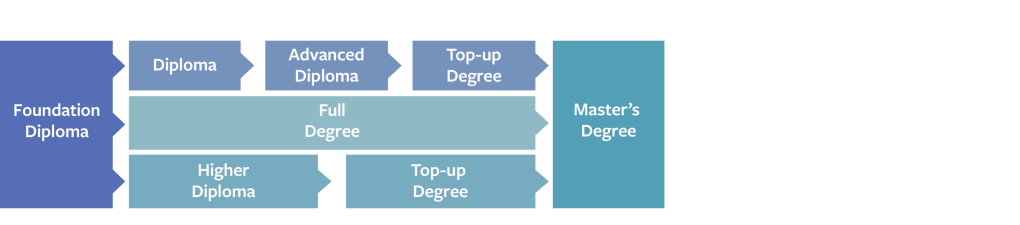
Progression Pathway @ LSBF Singapore Campus
THE LSBF DIfference
More Than a Qualification. An Employability Advantage.

Industry-Relevant Learning
Programmes built around the skills, technologies and capabilities relevant to today’s workplace.

Global Immersion
Take your learning beyond Singapore with opportunities for immersive experiences in Kuala Lumpur and/or Shanghai.

International Faculty
Learn from faculty and practitioners who bring international academic and professional perspectives into the classroom.

AI Integrated into Learning
Don’t just study AI. Learn to work with it. AI tools, applications and AI-enabled ways of working integrated across the LSBF learning experience.

Industry in the Classroom
Learn beyond textbooks through industry participation in programme delivery, including select modules delivered by Industry Professionals.

The LSBF Trust
A global education brand with an established international footprint, academic partnerships, industry relationships and thousands of learners worldwide.
ELIGIBILITY
Who can apply for this programme
Minimum Academic Entry Requirement:
Students who have successfully completed either of the following
- 2:2 in an appropriate course, or equivalent level professional qualification, or significant demonstrable and subject-relevant work experience.
- We also welcome mature students who may not have formal qualifications or who may have a degree in another subject. Your prior learning and experience will be considered, as will attendance at a recognised Access to Higher Education.
Minimum English Language Entry Requirement
- Applicants who have studied prior qualifications in English requiring IELTS 6.5 overall with no component below 5.5, or an equivalent recognised test.
- if your current IELTS or equivalent score is below the standard requirement, any of the following is accepted:
- A degree qualification taught in English from specific countries
- The Dynamic Placement Test, with a band score of B2-C1, is also accepted as an equivalent English Language test.
Minimum Age
- 21 years or above




TUTION FEES (Prices inclusive of GST)
SGD $23,980.00*
(local students)
SGD TBA
(international students)
* S$9,000 Financial Assistance for Local Students
– All eligible local students enrolling in the UEL MBA with Specialisation for the applicable intake will receive S$9,000 in financial assistance, subject to the programme’s terms and conditions.
– After the financial assistance, the net tuition fee is S$14,170 (GST inclusive)
Terms and conditions apply. Financial assistance is applicable to eligible local students for the specified intake only and is subject to fulfilment of the applicable enrolment and admission requirements. LSBF reserves the right to amend the financial assistance scheme, eligibility criteria and applicable intake terms without prior notice.
FAQs
Is this programme eligible for SkillsFuture (SSG) or Post-Secondary Education Account (PSEA) funding?
SkillsFuture (SSG) and Post-Secondary Education Account (PSEA) funding are currently applicable only to selected programmes offered by public institutions such as NUS, NTU, and SMU. While this programme is not covered under those schemes, we’re pleased to offer exclusive rebates and promotional rates. To learn more about the available fee support and eligibility, please contact our Education Consultants at +65 6580 7700 or get in touch here.
What career opportunities are available after this degree?
You’ll be equipped for roles such as international business consultant, regional operations manager, trade analyst, or global marketing executive.
What can I study after this degree?
You may pursue professional development in areas like supply chain, entrepreneurship, or digital transformation through short courses or microcredentials.
What if I want to pivot away from business?
That’s okay. Your cross-cultural understanding and strategic thinking are applicable in general management, marketing, or consultancy roles.
How do I get started?
Reach out to our expert education consultants at +65 6580 7700 or visit us at 80 Robinson Road, #01-00, Singapore 068898. We’re here to help you plan your next step.