
OVERVIEW
About this Programme
Counselling and Psychotherapy encompass a wide range of talking therapy approaches for an infinite number of concerns, delivered across a variety of contexts, time-spans and methods.
This course gives counsellors the opportunity to learn to research and to delve deeper into what it means to be a thoughtful, courageous and relational practitioner in today’s therapeutic context. Existential, interpersonal and spiritual ideas all feature as themes.

Ranked as one of the Top 30 Universities in the UK (Guardian University Guide)
Ranked Top 15 for Psychology and Social Work in the UK (Guardian University Guide)

Guided career sessions
MODULES
Advance your therapeutic career through reflective study
The programme aims to develop ethically grounded, reflective counselling professionals with advanced knowledge of psychotherapeutic theories, applied practice, and research methods. Learners will cultivate inclusive and sustainable professional values, effective communication and reflexive skills, and the ability to apply counselling approaches across diverse contexts. Through the reflective scientist-practitioner model, students will design and conduct research that informs evidence-based practice and contributes to the advancement of the counselling profession.
Research Methods and Ethics
This module aims to develop your knowledge, understanding and critical awareness of research methodologies, philosophies and methods pertinent to counselling and psychotherapy themes. In addition, it will move students closer to specifying their research interests and project topic.
There will be a particular focus on the links and points of coherence between ontology, epistemology, techniques and dissemination, and more practically, on scope, remit and project management. The importance of ethics and how to pass an ethics approval process will also be included.
Existence and Experience
This module fosters a critical and experiential exploration of human experience through the lens of Gestalt, Existential and Person-centred ideas. After an orientation to each approach in the early part of the module, the sessions move through a wide range of aspects of being a human in the world today with the aim of expanding your contextual understanding of self and other.
Contact and Connection
This module will engage you on a number of different levels, encompassing many different aspects of connecting with ourselves and others. The module is designed to be in two halves; equipping you with a wide range of skills to work in extra-therapeutic and systemic ways with others including group facilitation, supervision, teaching and leadership, as well as examining how becoming more in tune with our instincts and somatic experiencing affects our ability to connect on a deeper level in relationship.
Spirituality and Transpersonal Perspectives
The module will equip you with in-depth knowledge but more importantly, stimulating experiential learning and the ability to explore and assess multiple spiritual and transpersonal perspectives. Topics may include: ritual and ceremony; sacred and therapeutic spaces; altered states; religion vs Humanism; creativity and expression; spiritual growth; dreams and symbolism; human consciousness, and Jung’s sense of ‘the shadow’ (and the integration of disparate parts of the self).
Embracing the Unknown
This module consolidates elements of those which have gone before in the programme, bringing together: the need for research findings to be uncovered via a voyage of discovery rather than confirmation bias, sitting with uncertainty in therapy, and being more open to our own untapped potential.
Counselling and Psychotherapy Independent Research Project (Final Dissertation)
The dissertation will show evidence of ability to: identify problem and interest areas, locate issues within a wider context, obtain relevant data, analyse findings, work within relevant theoretical/conceptual frameworks, synthesise complex material, employ relevant and innovative research approaches, and present findings and propositions in an accessible manner.

Request more information
Get details and learn about the advantages of learning with LSBF.
what to expect
Work on real-world problems
Programme Aims
This Master’s degree seeks to give students a broad and exciting range of experiences, from deepening their existing understanding of connecting with clients and themselves, to managing a research project which has real meaning and resonance for them.
In a changing professional landscape, the ability to draw on critical thinking to find sustainability practices for both yourself and the world of counselling is invaluable.
Learning Outcomes
Research and Scholarly Practice
Graduates will be able to:
Demonstrate advanced competence in research design, methodology, and analysis, including ethical considerations, critical evaluation, and the production of independent, original research presented in accordance with academic conventions.
Theoretical and Conceptual Knowledge
Graduates will demonstrate the ability to:
Exhibit systematic understanding of key counselling and psychotherapy theories, alongside critical engagement with contemporary research and the complexities of human experience across diverse contexts.
Professional and Interpersonal Competence
Graduates will be equipped to:
Apply advanced communication, facilitation, and leadership skills within therapeutic and related settings, demonstrating awareness of diversity, power dynamics, and professional practice requirements.
Reflective and Integrative Practice
Graduates will also develop:
Critically reflect on personal and professional development, integrating experiential learning, self-awareness, and transpersonal perspectives into a coherent and informed approach to practice.
Skills you will acquire

N/A
median Singapore salary for Business
92%
Student passing rate
programme structure
attendance requirements
International Students: Full-time Day 90%
Local domestic students: Full-time Day and Evening 75%
Teacher student ratio
1:100
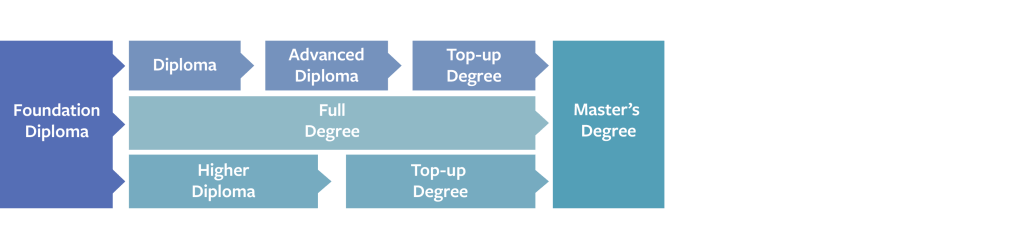
Progression Pathway @ LSBF Singapore Campus
STUDENT SUPPORT SERVICES
Why choose LSBF for your education

Study Materials
Students will receive study materials after they have made full payment for their programme. Replacement of study materials is subject to additional charge.

Student Portal
Students have access to the Student Portal. It is a useful site where the course information and learning materials are available for students’ easy reference.

Accessible Faculty
Students may contact their lecturers directly via email outside the lecture hours for any academic related queries.

Recorded Lectures
We will show compassion and care to all stakeholders as we believe the journey is as important as the outcome.
ELIGIBILITY
Who can apply for this programme
Minimum Academic Entry Requirement
Applicants need to meet certain entry requirements when they apply for this course which is only open to qualified professional counsellors/ psychotherapists/ psychotherapeutic counsellors.
- Registration as a qualified counsellor in any country
- A minimum of a Diploma in Counselling including 100 supervised practice hours
- 50 post-qualifying supervised practice hours
- A minimum 2:2 (Hons) degree (or equivalent) in any subject
- An academic reference.
- A personal statement outlining your interest in the MA and areas of interest for research.
- We would normally expect applicants to have Grade 4 / C in GCSE English and Maths.
- All suitable applicants are required to attend an interview.
- An enhanced DBS check.
- We also welcome mature students who may not have formal qualifications or who may have a degree in another subject. Your prior learning and experience will be considered, as will attendance at a recognised Access to Higher Education.
Minimum English Language Entry Requirement
Applicants who have studied prior qualifications in English requiring IELTS 6.5 overall with no component below 5.5, or an equivalent recognised test.
The Dynamic Placement Test, with a band score of B2-C1, is also accepted as an equivalent English Language test.
Minimum Age
21 years or above


TUITION FEES (Inclusive GST)
SGD $16,350.00
(local students)
SGD $23,980.00
(international students)
FAQs
Is this programme eligible for SkillsFuture (SSG) or Post-Secondary Education Account (PSEA) funding?
SkillsFuture (SSG) and Post-Secondary Education Account (PSEA) funding are currently applicable only to selected programmes offered by public institutions such as NUS, NTU, and SMU. While this programme is not covered under those schemes, we’re pleased to offer exclusive rebates and promotional rates. To learn more about the available fee support and eligibility, please contact our Education Consultants at +65 6580 7700 or get in touch here.
What career opportunities are available after this degree?
This MBA prepares you for leadership roles such as business development manager, general manager, regional director, or entrepreneur across global industries.
What can I study after this degree?
You may pursue executive education, niche professional certifications, or consider doctoral-level studies such as a DBA or PhD.
What if I’m unsure about committing to a leadership path?
That’s okay. The MBA still enhances your versatility, making you valuable in mid-level management, project leadership, or consultancy roles.
How do I get started?
Reach out to our education consultants at +65 6580 7700 or visit us at 80 Robinson Road, #01-00, Singapore 068898. We’re here to help you plan your next step.