
OVERVIEW
About this Programme
Interested in advancing your skills or pivoting to a future-proof career in tech? The Diploma in Information Technology (DIT) in Singapore offers an immersive, hands-on learning experience that helps you build a strong foundation in the technologies, systems, and problem-solving approaches that power today’s digital world.
You will learn the practical skills employers look for, from coding and software development to testing, problem-solving and cloud-based technologies. More importantly, this information technology course will help you understand how these skills come together to support modern business operations and digital innovation.
Available in full-time, part-time, and blended learning formats, this Diploma in IT programme gives you the flexibility to study around your goals and commitments. On completion, you can pursue entry-level roles in IT support, software development, or network administration, or continue your studies through the progression pathway to a Bachelor’s Degree in Computer Science or Cyber Security Networks awarded by the University of East London at LSBF Singapore Campus.

42% of the 2024 cohort earned distinctions

Industry-backed training from Palo Alto Networks and AWS Educate

Build job-ready programming, cloud computing and software development skills

Gain high-demand practical expertise directly from active tech practitioners.
MODULES
A programme designed to explore beyond subject knowledge
Created to reflect the evolving needs of the technology industry, these modules provide hands-on exposure to the core disciplines of IT. You will learn core programming, software development, and systems design, while also building critical skills in networking, databases, and cybersecurity.
Information Systems Modelling & Design
This module develops the skills and techniques required for creating an overall plan for the design of software, design of functional specifications based on user and business requirements incorporating various controls, functionality, and interoperability of different elements into a designing an information system, modelling which describes the overall architecture in software, databases, hardware, and third-party frameworks that the software will use or interact with. It also covers some of the key legal, social, ethical, and professional issues relating to the information systems development.
Maths for Computing
This module introduces the basic concept of quantitative approaches to computing mathematics. This module will help students to attain essential knowledge in mathematical concepts and skills that are required for the study and application of computer science.
Software Development
This module provides students with technical skills, communication skills, to develop applications by coding, testing, debugging, documenting, and reviewing in accordance with object-oriented programming standards for development and security. The module focuses on programming fundamentals such as introduction to computers and object-oriented programming, basic computation, variables, control structures, arrays, and the procedural programming methodology. It then progresses to introduce the object-oriented programming concepts of objects, classes, and inheritance.
Computer Systems & Networks
This module focuses on fundamental computer architecture, network fundamentals, protocols, and models. This module introduces the categories of the network functions, evaluates, and justifies networks, and device performance using the OSI model and the most widely used TCP/IP protocol suite.
Web Technologies
This module provides students with practical skills to examine, translate complex software ideas and concepts into a web application and establish key design principles and methodologies. Students can select and use appropriate tools and techniques with which to design, build, implement, and test a web application. This module also provides the opportunity to gain work skills to be able to provide professional documentation for the web pages produced.
Cloud Computing
This module provides students with a detailed and essential foundation in cloud computing. Cloud computing is the up and rising technology that will be considered critical in today’s business world. This introductory module to cloud computing describes and explains fundamental aspects of cloud computing concepts, models, technologies, and applications.
Security Architecture
This module introduces students to design security architectures and controls; either introducing security principles into the design of architectures to mitigate the risks posed by new technologies and business practices, or the actual design and specification of applicable security components, along with the incidental control measures, to meet defined business security needs.
Security Administration
This module introduces students to the fundamental concepts with hands-on practice of how to administer, configure and update security programmes and mechanisms, including the application of system patches to ensure that enterprise assets are adequately protected against threats. This also includes the authorisation, management, and monitoring of access control permissions and/or rights to various IT facilities.

Request more information
Get detailed breakdowns and learn about the advantages of learning with LSBF Singapore Campus.
what to expect
Prepare for a Career in IT
Programme Aims
- Design and be able to implement high quality and robust software products with secure features, run routine application tests, and conduct debugging to resolve errors
- Professionally analyse and design information systems
- Demonstrate effective inter-personal skills when working in groups or leading teams
- Professionally communicate and present proposals, findings and results
- Pursue higher level studies at universities
Learning Outcomes
- Analyse user requirements and design solutions both efficiently and effectively
- Elaborate and propose information systems that meet user requirements and demands
- Propose, evaluate, and implement computerised solutions to meet varying levels of user requirements
- Develop applications in line with design specifications, utilising a range of tools, methodologies, programming, and externally developed codes
- Review recommendations to improve the overall functionality, usability, and security of applications against cost, efficiency, and viability considerations
- Possess effective communication, teamwork, and leadership skills
- Present proposals and recommendations in a professional and efficient manner
Skills you will acquire

$3,000
median Singapore salary for Technology
92%
Student passing rate
Polytechnic GES 2025 – Information & Digital Technologies
programme structure
Assessment, graduation and awards
Assessment methods may vary according to individual module requirements and each module is assessed by:
- Continuous Assessment, Formative and Summative Assessments
- Any combination of class participation, group or individual applied assignments, tests or online quizzes, portfolio, practical examinations, and written examinations
- Students may advance to attempt the AWS Certification examination and will be awarded a certificate meeting the AWS Educate Certification examination requirement.
Graduation requirements:
Students must take and satisfactorily complete all modules to be awarded the LSBF Higher Diploma in Advanced Technology and AI. All students must complete all modules. Student must achieve an overall passing grade of 40%. Students who fail a module at the first attempt are permitted two (2) further opportunity to pass the module (resit) and failure of this retake will require students to sit the failed module(s) again in full prior to additional retake attempt.
Attendance requirements
International Students: 90%
Local, PR, non-student pass: 75%
Technical Pre-requisites
| Component | Minimum | Recommended |
| Processor | 1.6 GHz or faster, 2-core Intel Core i5 or equivalent | 1.8 GHz, 2-core Intel Core i5 or equivalent |
| Memory | 6 GB RAM | ≥8 GB RAM |
| Hard Disk | 256 GB disk size | Sufficient free space to install trial software to be downloaded |
| Display | 1280 x 768 screen resolution (32-bit requires hardware acceleration for 4K and higher) | – |
Teacher Student Ratio
40:1 for Lecture/classroom/Seminar
24:1 for Computer Lab
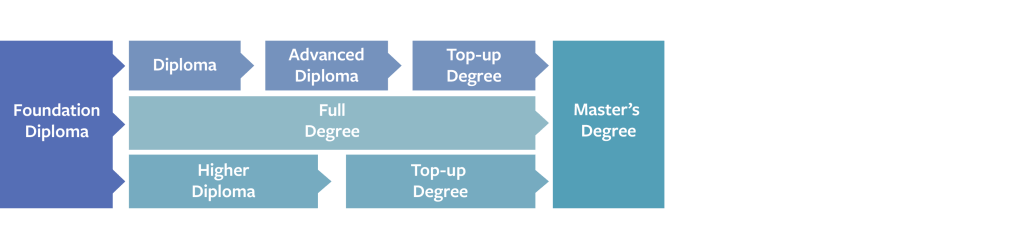
Progression Pathway @ LSBF Singapore Campus
THE LSBF DIfference
More Than a Qualification. An Employability Advantage.

Industry-Relevant Learning
Programmes built around the skills, technologies and capabilities relevant to today’s workplace.

Global Immersion
Take your learning beyond Singapore with opportunities for immersive experiences in Kuala Lumpur and/or Shanghai.

International Faculty
Learn from faculty and practitioners who bring international academic and professional perspectives into the classroom.

AI Integrated into Learning
Don’t just study AI. Learn to work with it. AI tools, applications and AI-enabled ways of working integrated across the LSBF learning experience.

Industry in the Classroom
Learn beyond textbooks through industry participation in programme delivery, including select modules delivered by Industry Professionals.

The LSBF Trust
A global education brand with an established international footprint, academic partnerships, industry relationships and thousands of learners worldwide.
ELIGIBILITY
Who can apply for this programme
Local student Entry Requirements
Minimum Academic Requirement:
- At least two passes in GCE ‘A’ Level
- International Baccalaureate (24 points)
- Local Polytechnic Diploma in any field
Minimum English Language Requirement:
- Achieved grade C6 or better in the English language in ‘O’ level
- Passed in the English Language in Year 10 High School qualification or equivalent
- Achieved IELTS 5.5/TOEFL 500
- Completed LSBF Preparatory Course in English Upper Intermediate Level
- Successfully passed the LSBF English Placement Test
Minimum Age
18 years old
Students with non-standard entry requirements (e.g. other PEI qualification etc) will be assessed on a case-by-case basis subject to approval of the Academic Board.
international student Entry Requirements
Minimum Academic Requirement:
- Completion of Year 12 High School Qualification or equivalent qualification from respective home countries
- Completed International Baccalaureate (24 points)
- Equivalent Local Polytechnic Diploma in any field in respective home countries
Minimum English Language Requirement:
- Achieved grade C6 or better in the English language in ‘O’ level
- Passed in the English Language in Year 10 High School qualification or equivalent
- Achieved IELTS 5.5/TOEFL 500
- Completed LSBF Preparatory Course in English Upper Intermediate Level
- Successfully passed the LSBF English Placement Test
Minimum Age
18 years old
Students with non-standard entry requirements (e.g. other PEI qualification etc) will be assessed on a case-by-case basis subject to approval of the Academic Board.







TUTION FEES
(Prices inclusive of GST)
SGD $6,322.00
(local students)
SGD $8,074.07
(international students)
FAQs
Is this programme eligible for SkillsFuture (SSG) or Post-Secondary Education Account (PSEA) funding?
SkillsFuture (SSG) and Post-Secondary Education Account (PSEA) funding are currently applicable only to selected programmes offered by public institutions such as NUS, NTU, and SMU. While this programme is not covered under those schemes, we’re pleased to offer exclusive rebates and promotional rates. To learn more about the available fee support and eligibility, please contact our Education Consultants at +65 6580 7700 or get in touch here.
What career opportunities are available after this diploma?
Graduates may pursue roles such as IT support technician, junior developer, systems assistant, or network technician in SMEs and tech companies.
What can I study after this diploma?
Graduating from this IT diploma qualifies you to progress further into two specialised bachelor’s degree programmes awarded by the University of East London (UEL):
1.BSc (Hons) Computer Science
2.BSc (Hons) Cyber Security and Networks
Our structured academic pathway allows you to smoothly transition from your diploma into a UK degree right here in Singapore.
What if IT isn’t the right fit for me?
That’s completely fine. The skills you gain in this Diploma in IT programme—such as logical thinking, problem-solving, and digital literacy—are valuable in many industries beyond traditional IT roles. For example, you could explore career paths such as Data Analyst, IT Business Analyst, or Digital Operations Executive, where technology knowledge is combined with business and operational skills.
You may also choose to transition into related fields such as business or logistics through further study. The skills you develop here can give you a strong foundation and the flexibility to pursue different career directions as your interests and goals evolve.
Is there financial support available for this programme?
Yes, LSBF’s diploma programmes are eligible for UTAP (Union Training Assistance Programme) funding. NTUC members can receive 50% course fee support, capped at S$500 per year. To apply, submit your UTAP application through the NTUC website within 6 months of completing your course. You can also learn more via e2i.com.sg.
Do I need prior coding or programming experience to enroll in this diploma?
No, you do not need any prior coding or programming experience to enrol. Our Diploma in Information Technology in Singapore is specifically designed for beginners and career switchers. The entry criteria require no prior IT knowledge, meaning we start from the absolute basics. You will be guided step by step through foundational tech concepts, ensuring you build your skills and confidence from the ground up.
What programming languages and technologies will I learn during this diploma?
In this information technology course, we focus on practical skills that employers look for. You will learn the core technologies used to build websites, write software, and run modern business systems.
The key languages and technologies you will learn are:
- Object-Oriented Programming (Java/Python): In your Software Development module, you will learn the basics of coding. You will start with simple logic and progress to building real-world software applications using industry-standard languages such as Java or Python.
- Cloud Computing (AWS): Almost every modern IT system runs on the cloud. In your Cloud Computing module, you will learn how the cloud works. Through LSBF’s partnership with AWS Educate, you’ll enjoy practical experience with Amazon Web Services (AWS) tools, helping you confidently launch and manage cloud systems.
- Web Technologies (HTML, CSS, JavaScript): You will learn how to build and test functional web applications and understand how the front-end (what users see) communicates with back-end servers.
- Networking and Security Tools: You will learn how computers function safely using network protocols (like TCP/IP) and work with tools used to configure, update, and protect company data against security threats.
What entry-level IT roles and salary ranges can I qualify for in Singapore after completing this diploma?
After completing the Diploma in Information Technology at LSBF in Singapore, you may qualify for entry-level roles such as
- Junior Application Developer/Web Programmer
- IT Support Analyst/Helpdesk Specialist
- QA Tester (SGD 2,800–4,000)
- Junior Network Administrator
Salaries for these entry-level roles can range from S$ 2,500 to S$4,000. As the future of work becomes increasingly technology-driven, the sector remains rich with opportunities. Singapore’s digital economy supported 214,000 tech jobs in 2024, with demand expected to grow further. Developing AI-related skills alongside your IT knowledge can help you access even more career opportunities in the years ahead.
What is the difference between the Diploma, Advanced Diploma, and Higher Diploma in Information Technology/Computer Science at LSBF?
Info Tech courses at LSBF Singapore Campus have two pathways: Diploma and Higher Diploma programmes. Diploma programmes are a great starting point if you are new to technology and want to build core IT and digital skills.
Higher Diploma programmes in technology will help you gain deeper knowledge in specialised areas such as computer science, cybersecurity, data science and artificial intelligence. These programmes explore more advanced concepts and can help you in further study or specialised IT careers.
The right option depends on your academic background, career goals, and the level of specialisation you wish to achieve.
Does this programme prepare me for any industry certifications, such as CompTIA, AWS, or Microsoft Azure?
The concepts you learn in our IT course in Singapore provide an academic baseline that closely aligns with the knowledge required for industry certifications, such as CompTIA Security+, AWS Cloud Practitioner, or Microsoft Azure Fundamentals. This makes it easier for you to pursue these professional certifications alongside or after your studies.
Can I take this diploma part-time while working, and how are classes scheduled for part-time students?
Absolutely. We understand that many professionals look for IT courses in Singapore to upgrade their skills while maintaining full-time employment. This diploma is offered as a flexible 12-month part-time programme. To accommodate working adults, part-time classes are conveniently scheduled in the evenings or on weekends, allowing you to balance your daily work responsibilities with your academic growth without disruption.