OVERVIEW

About this Programme
LSBF Singapore Campus’ Diploma in Logistics and Supply Chain Management equips you with essential skills in procurement, warehousing, and transportation. Offered on a full-time or part-time basis, this course in logistics and supply chain management is designed for aspiring professionals seeking a recognised supply chain management diploma in Singapore to advance their careers in operations and logistics. Upon completion, graduates will receive dual certifications: the Diploma in Logistics and Supply Chain Management awarded by LSBF Singapore Campus and a Certificate of Attendance issued by Deloitte.

42% of the 2024 cohort earned distinctions

Unlock a UK degree pathway in just 16 months

Blended Learning: Face-to-face and Live Broadcast

Learn from expert educators and industry practitioners
MODULES
Designed to explore beyond subject knowledge
This Diploma in Logistics and Supply Chain Management equips students with foundational knowledge in logistics and business operations, providing a comprehensive understanding of supply chain systems and practices across industries.
Graduates will develop expertise in logistics strategies and gain a critical understanding of supply chain processes, including their development and application in real-world scenarios. As one of the practical supply chain courses in Singapore, this qualification prepares students to navigate complex operational challenges with confidence and strategic insight.
Principles of Management
The aim of this module is to provide students with an introduction to the principles and practices of management. Students will learn how to examine the nature of managerial work including strategy, operations and project management, control, ethics, structures and culture, organisational power, groups and teams, individual performance and stress, social responsibility and change management.
Statistics and Quantitative methods for Business
This course introduces the basic concept of quantitative approaches to decision making. It introduces students to basic concepts of and methods of qualitative methods used by Management. Enables students to understand how to collate and present data, apply and range of statistical and operations research techniques.
Principles of Accounting
This module introduces students to the foundation and understanding of the principles and concepts of Accounting. Students will be exposed to the application of these accounting concepts in the preparation of financial statements for use by individuals, business, non-profit organisations and government institutions. Students will also be developing expertise in using these accounting principles and concepts in their analytical approach to financial problem-solving.
Principles of Economics
The module is an introduction to basic economic principles and concepts and how they apply to the business environment. It introduces students to the global economy and reviews both the national and the global market. It establishes the framework for future courses by providing students with an overview of fundamental micro and macroeconomic concepts.
Introduction to Logistics
This module focuses on international Logistics and Supply Chain Management, key of which involves the integration of information and strategic decisions on transportation, inventory, material flow, and resources.
Principles of Marketing
This course seeks to equip students with an understanding of the role of Marketing. It outlines the fundamental principles, concepts and techniques. It provides students with the opportunity to examine marketing theories and approaches and the value of marketing management in achieving corporate success in an increasingly competitive business environment.
Supply Chain Management
This module focuses in international Logistics and Supply Chain Management, key of which involves the integration of information and decisions on transportation, inventory, material flow, and resources.
Artificial Intelligence (AI) & Data Analysis for Business Decisions
This module will introduce students to the concepts and methods of data analytics and use open source GUI tools (point and click) to perform key statistical tests, data modelling and visualization of results from business data decision making and draw useful interferences from data. Students will be introduced to key concepts of statistical tests, data mining algorithms, evaluation of models and results as well as effective presentation of results.
Industrial Attachment Program
Industrial Attachment is part of students’ educational development. This enables theoretical learning in the classroom to be applied to practical learning situations and encourages application of theory and knowledge in appropriate context. Where students are unable to undertake an Industrial Attachment they will be offered the option of a written Project. Industrial Attachment applies to all full-time STP holders.
For Part-time students or Full-time non-STP holders, to complete the Diploma they must show that they either have a minimum of 6 months relevant working experience or complete the written Project. In certain circumstances non-STP may opt for the Industrial Attachment.

Full programme structure and learning outcomes
Get details and learn about the advantages of learning with LSBF.
what to expect
Kickstart Your Career in Logistics
Programme Aims
- An understanding of the core concepts, theories and techniques in the Logistics & Supply Chain Management field
- An introduction to the latest technology and development in the Logistics & Supply Chain Management industry
- Develop competence in the areas of study and solutions to problems in industry.
- To enhance an awareness of the business, legal and social responsibilities of logistics operations.
- Synthesise the requirements of industry regulatory systems
- A high degree of effectiveness within the industry by providing a wide range of relevant knowledge and skills to complement their experience in their scope of work
Learning Outcomes
- Distinguish trends of the past decade and make informed estimates of likely future developments .
- Demonstrate knowledge of organisations, the external environment in which they operate and how they are managed
- Analyse strategic issues
- Evaluate the appropriateness of different approaches to solving problems
- Show an understanding of logistics and supply chain management and practices in the context of their chosen specialisation
- Communicate the results of their study/work accurately and reliably, and with structured and coherent arguments
Skills you will acquire

$2,830
median Singapore salary for Logistics
92%
Student passing rate
Polytechnic GES 2025 – Business
programme structure
Attendance requirements
International Students: 90%
Local, PR, non-student pass: 75%
Industrial Attachment Programme
Industrial Attachment is part of students’ educational development. This enables theoretical learning in the classroom to be applied to practical learning situations and encourages application of theory and knowledge in appropriate context. Where students are unable to undertake an Industrial Attachment they will be offered the option of a written Project.
To be eligible for Industrial Attachment a student must have passed a minimum of 4 modules during their course of study.
Students who commence an Industrial Attachment and subsequently fail to complete this will not be awarded the Diploma in Logistics and Supply Chain Management but will be awarded Certificate in Logistics and Supply Chain Management as an Exit award.
Students who opt to source their own Industrial Attachment and who subsequently fail to secure this will be awarded the Certificate in Logistics and Supply Chain Management as an Exit award.
The Industrial Attachment is considered to be an integral part of the Diploma. In the unlikely event that a student cannot be placed for IA LSBF will allow the student to complete a 2,500 word Project in a maximum of 2 months.
Where students specifically request they may be granted the option of completing a Project rather than undertake the Industrial Attachment. The project (2,500 words) topic is assigned by the School, students have a maximum of 2 months to complete the project after approval. Students must still meet the same eligibility requirements (4 passes) to take the Project.
Teacher student ratio
1:120
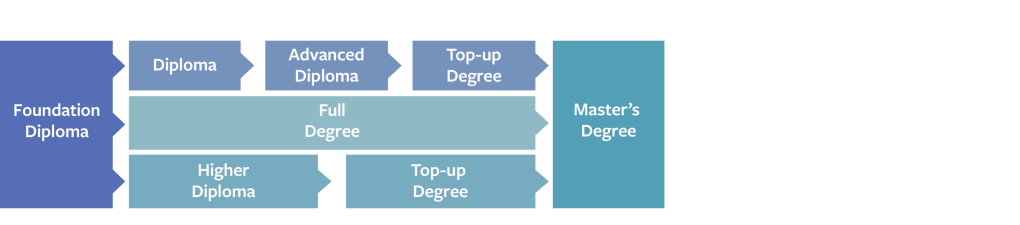
Progression Pathway @ LSBF Singapore Campus
THE LSBF DIfference
More Than a Qualification. An Employability Advantage.

Industry-Relevant Learning
Programmes built around the skills, technologies and capabilities relevant to today’s workplace.

Global Immersion
Take your learning beyond Singapore with opportunities for immersive experiences in Kuala Lumpur and/or Shanghai.

International Faculty
Learn from faculty and practitioners who bring international academic and professional perspectives into the classroom.

AI Integrated into Learning
Don’t just study AI. Learn to work with it. AI tools, applications and AI-enabled ways of working integrated across the LSBF learning experience.

Industry in the Classroom
Learn beyond textbooks through industry participation in programme delivery, including select modules delivered by Industry Professionals.

The LSBF Trust
A global education brand with an established international footprint, academic partnerships, industry relationships and thousands of learners worldwide.
ELIGIBILITY
Who can apply for this programme
Local students Entry Requirements
Minimum Academic Requirement:
- Two passes in GCE A Level Examinations, or
- International Baccalaureate (24 points)
- Local Polytechnic Diploma in any field
Minimum English Language Requirement:
- Achieved a grade C6 or better in English language O level, or
- Pass in English Language in Year 10 High School qualification or equivalent
- IELTS 5.5/TOEFL 550
- Completed LSBF Preparatory course in English Upper Intermediate Level
Minimum Age
18 years old
Students with non-standard entry requirements (e.g. other PEI qualification etc) will be assessed on a case-by-case basis subject to approval of the Academic Board.
International students Entry Requirements
Minimum Academic Requirement:
- Completion of Year 12 High School Qualification or equivalent qualification from respective home countries
- Completed International Baccalaureate (24 points)
- Equivalent Local Polytechnic Diploma in any field in respective home countries
Minimum English Language Requirement:
- Achieved a grade C6 or better in English language O level, or
- Pass in English Language in Year 10 High School qualification or equivalent
- IELTS 5.5/TOEFL 550
- Completed LSBF Preparatory programme in English Upper Intermediate Level
Minimum Age
18 years old
Students with non-standard entry requirements (e.g. other PEI qualification etc) will be assessed on a case-by-case basis subject to approval of the Academic Board.





TUITION FEES (Price inclusive of GST)
(Final-Year Entry)
SGD $5,777.00
(local students)
SGD $8,074.07
(international students & progression)
FAQs
Is this programme eligible for SkillsFuture (SSG) or Post-Secondary Education Account (PSEA) funding?
SkillsFuture (SSG) and Post-Secondary Education Account (PSEA) funding are currently applicable only to selected programmes offered by public institutions such as NUS, NTU, and SMU. While this programme is not covered under those schemes, we’re pleased to offer exclusive rebates and promotional rates. To learn more about the available fee support and eligibility, please contact our Education Consultants at +65 6580 7700 or get in touch here.
Is the industrial attachment (IA) compulsory, and who arranges placements — LSBF or the student?
LSBF Career Office will prepare students for interviews with participating employers through interview coaching and employability guidance. An Industrial Attachment (IA) Briefing will also be conducted to familiarise students with the internship process, expectations, workplace professionalism, and assessment requirements prior to their placements.
Can I be exempted from the industrial attachment if I am already working in logistics or supply chain?
Yes, applicants will be required to provide a valid employment letter stating their job title and employment status. The letter must be issued by the employer for verification purposes.
What specific roles and salary ranges can I expect to qualify for in Singapore after completing this diploma?
Graduates of the Diploma in Logistics and Supply Chain Management may pursue roles such as Logistics Coordinator, Procurement Executive, Inventory Analyst, Warehouse Supervisor, and Supply Chain Executive. Salaries in Singapore vary depending on the role, employer, industry, qualifications, and prior experience. Logistics and supply chain professionals in Singapore can expect starting salaries from S$2,500 per month.
How does Singapore’s position as a global logistics hub benefit students in this programme?
Singapore is one of the world’s leading logistics hubs, with world-class ports, air cargo facilities, and extensive global trade connectivity. Studying the Diploma in Logistics and Supply Chain Management in Singapore allows students to develop industry-relevant knowledge and practical skills.
What is the difference between the Diploma, Advanced Diploma, and Higher Diploma in Logistics and Supply Chain Management at LSBF?
The Diploma in Logistics and Supply Chain Management provides a foundation in logistics and supply chain principles. The Advanced Diploma builds on this foundation with more specialised logistics knowledge and includes an Industrial Attachment for practical industry experience. The Higher Diploma offers a broader curriculum that combines logistics with business management and emerging areas such as artificial intelligence (AI) and data analytics.
What logistics and supply chain management courses does LSBF offer?
Reach out to our expert education consultants at +65 6580 7700 or visit us at 80 Robinson Road, #01-00, Singapore 068898. We’re here to help you plan your next step.
Is this diploma in logistics and supply chain management a recognised qualification?
Yes, upon successful completion, students will receive the Diploma in Logistics and Supply Chain Management from the LSBF Singapore Campus, along with the Certificate of Attendance from Deloitte.
What can I study after this diploma?
You may progress to the Advanced Diploma in Logistics and Supply Chain Management, followed by the University of Greenwich’s Bachelor of Arts (Honours) in Business Logistics and Transport Management (Top-Up). The Top-Up degree can be completed in 8 months (full-time) or 12 months (part-time).
What if I decide not to stay in logistics?
That’s alright. The knowledge and skills gained through this programme are transferable to a range of business functions. Graduates may pursue roles in operations, procurement, inventory management, and e-commerce, or continue their studies in business, data analytics, or IT.
Is there financial support available for this programme?
Yes, LSBF’s diploma programmes are eligible for UTAP (Union Training Assistance Programme) funding. NTUC members can receive 50% course fee support, capped at S$500 per year. To apply, submit your UTAP application through the NTUC website within 6 months of completing your course. You can also learn more via e2i.com.sg.